What I Actually Do When a Functional Food Brand Brings Me a Product That Tastes Terrible
Mar 27, 2026
I have tested some truly, truly challenging things in my career. Products that made my body physically react. Products where I had to take a step back, reset and think, right, where am I going to start with this? Today, I want to take you behind the scenes of what I'm actually doing when a functional food brand brings me a product that, let's say, is a work in progress.
Most of the clients who come to me as a flavour expert have one thing in common. They have a functional product, maybe they have a sport nutrition range, maybe it's a coffee replacement with adaptogens. Maybe it's a plant-based drink or a collagen supplement or a vegan omega-3.
Something where the ingredients are genuinely impressive, genuinely good for you, but also genuinely challenging for the taste.
They've Chosen Incredible Ingredients, But the Flavour Got Left Behind
And I want to be very clear here. I say that with absolutely no disrespect for my clients. They have chosen incredible ingredients. They have done their research on health benefits. They know their stuff.
But somewhere in that process, the flavour conversation got left behind. Or it may have happened, but nobody really knew how to approach this properly.
So they come to me with their product and the brief is broadly, this doesn't taste great. Can you help us?
And I'm thinking, okay, let's start from the beginning because before I can fix anything or choose anything, I need to understand what exactly I'm working with.
First Thing: I Taste the Base
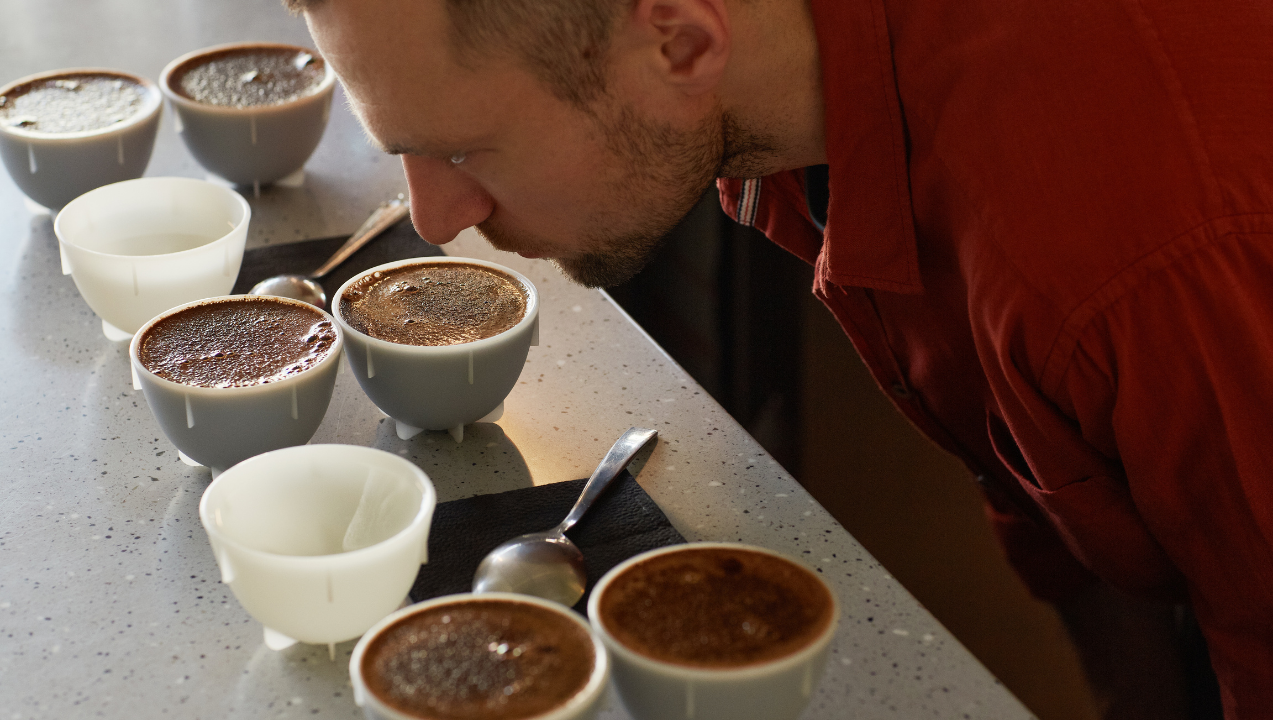
So the first thing I do is always to taste the base. When I say the base, I mean the product without any flavouring or natural flavouring or extract or anything that brings the taste. Just the raw product with all of its ingredients as it is.
And I want to tell you, some of these first tastings are, well, let's say an experience.
I had a vegan omega-3 supplement made from algae and I opened it, I smelled it and my body went literally like that. It was so fishy, so algae, the kind of smell that just hits you immediately. And I'm thinking, right, this is going to be a challenge. But at least I knew what I would work with.
I had a marine collagen, which was very similar, very fishy, but also very musty. And that was the kind of note that lingers and lingers after you swallowed. Which is actually one of the most difficult things to mask, by the way, because you can sometimes cover the initial tastes, but that aftertaste is another battle entirely.
I had a coffee replacement with adaptogens like lion's mane mushroom, maca or black tea. And the challenge there was this combination of earthiness and the taste of the mushroom, the astringency from the black tea. So it had multiple layers of difficult notes all at once.
And with the sport nutrition range, the base tasted almost savoury. It was very rye bread with very earthy notes, quite nutty, dark and roasted kind of way. And I'm thinking this has to end up as a sweet product because that is what the category is. Sport nutrition is almost always sweet flavour profile.
So I'm looking at the base. I'm looking at the flavours we want to develop and thinking, how am I going to bridge that gap?
What I'm Mapping in That First Tasting
So this first tasting, what I'm doing is literally mapping everything as a food scientist.
I'm going to go through the basic taste. So is it bitter, sour, salty, sweet, umami? Then I'm looking at the flavour characteristics. What are the off-notes? What is the dominant note? What is the secondary? What lingers?
I'm also looking at the mouthfeel. Is it gritty? Is it sandy? Is it smooth? Is it watery? Does it coat your mouth?
And I'm assessing the overall balance. Is there anything that is overpowering? Is there anything that is lacking?
And throughout all of this process, I'm already starting to think about flavour pairing. Which flavour profile might complement the base or help mask the off-notes? Which ones will definitely not work with it?
Because that comes from years of experience working in a flavour house, then working as a flavour specialist at McVitie's. And it means by the time I finish this first tasting, I'll already have a rough direction forming in my head.
But here's the thing. My direction is just my direction. I have a trained palate. I have sensitivity to certain notes and there are things that people may not even pick up on.
So if I just went ahead and chose the flavour based on my own analysis, that would not be right. It won't be the right approach because I'm not the target consumers and neither is my client.
The Flavour Workshop: Finding the North Star
The next step is the flavour workshop. And this is one of my favourite parts of the whole process for functional food brands.
What I do is I bring a lot of reference products. If the target profile is, for example, citrus, then I will bring some fresh citrus fruits, I will bring some citrus yogurt, I will bring some citrus sweets or drinks or baked goods, all different brands, all different quality levels, artisan or mass market.
And we taste them mindfully. Carefully, we describe what we actually taste and not whether we like it or not. Don't care about that. What the characteristics are.
I want to be honest about something here. When I host this kind of flavour workshop, I'm very careful about not influencing the room. Because like I mentioned before, my palate is trained. So I will pick up on notes that some people won't ever taste at all.
I don't want to influence them in any way. I don't want to be like, oh, if Manon says, it must be in it. No, no, no, no.
Instead, what I do is I guide people to describe what they're tasting and what they're experiencing. Especially when they say, oh, there is a note there, but I can't put my finger on what it is.
So I try to give them options if they are struggling to articulate a specific taste, for example. Because that is one of the biggest challenges in product development tasting.
It's not that people have a bad palate, which I hear all the time, it's that nobody has taught them how to describe what they are tasting accurately.
There is a huge difference between saying, I don't like it, or saying, it has quite a strong earthy note and bitterness in the aftertaste, quite lingering. You see the difference? One is a personal preference and you can't really act on it. And the other is actionable information.
We end the workshop with something called a North Star. So it's one or multiple benchmark products with specific flavour profile that everyone in the room agrees this is the direction we have to go for.
This is not a copy of the benchmark, but it's a reference point, something that is going to help us through the product development project, something that is concrete and that guides every single decision from that moment forward.
Writing the Brief for Suppliers
Now that I have the analysis of the base without anything that can flavour it, I have the North Star. I have clear directions. Now the real work can begin.
I write a very detailed brief for the suppliers. It can be a flavour house, it can be fruit and veg powders, it can be juice concentrate, anything that you use to flavour your product.
So I don't just ask for a mango puree or a vanilla flavour. It's a proper brief, a very long spreadsheet with the exact flavour profile that I'm looking for, the specific notes that I want, the ones that I don't want, the application, the ingredients, the deadline, the country where it's launched, everything.
Because if you go to a flavour house with no guidance, they literally have hundreds, even more options in their flavour library and they have no way of knowing which direction to take for you.
And I know this because this is exactly what I was doing. So I know how frustrating it is when clients give you absolutely nothing to work with.
The Trial Process: 50-200 Trials Per Project
So then I ask for a lot of samples because I want to give my clients options. When I say a lot, I really mean it. Per project, it can be between 50 and 100 trials for one single project and sometimes even more.
Other food scientists look at me like I'm completely insane when I tell them that, but I want to give my clients real options. Not this is one strawberry, this is one lemon. No, no, no, no.
I want to give them genuinely different directions in terms of flavour profile, different levels of intensity with different combinations, with different ingredient approaches, everything like that.
And it's not just about natural flavouring. It can be fruit juice concentrate, fruit juice powders, botanical extract, essences, oleoresins. It all works exactly the same way.
Even within one type of ingredient, say a mango puree, two different suppliers will give you two completely different flavour profiles. So having that detailed flavour brief is essential as part of your flavour strategy.
Then I do all of my trials, I pre-select, I taste everything myself first because I don't want to come to the clients and give them 50 samples. I narrow them down to the most interesting options, the ones I think work genuinely with the base.
And then I do the tasting with my client. And this is where I love to spend the full day with the client, if possible, because it avoids so much back and forth of tasting.
We taste everything together. Then I go to my little corner, I do some trials, and then we come back to do more tasting and adjustment. And we keep on iterating for the whole day.
What I Need to Hear in Tasting Sessions
Here is something I always say to my clients at the start of this kind of session. If someone in the room, and there is usually at least one person, says, I like it or I don't like it, I gently redirect them to what is really important here because that tells me nothing.
What I need is the earthiness is too strong, the sweetness is not quite right, we are not masking quite well the bitterness, the aftertaste is too bitter again, this feels flat, this is not complex enough.
That, all of these comments, this is what helps us to move forward to the next stage.
The Moment Everything Shifts
Most of the clients I work with who have a functional product or plant-based product, they already know the taste is a challenge. They know.
So they come to me because they want someone to be honest with them and give real feedback and a path forward. They need a proper flavour strategy.
I think this is one of the most meaningful parts about this work because when we get to that moment in the tasting where people in the room say, yes, this is it. We are on the right path. We are in the right direction. We are almost there. We can see the light at the end of the tunnel.
The energy completely shifts. They feel they have now control of their flavour strategy and they know exactly what they're doing and where they are going.
Get Expert Help for Your Functional Product
If you have a functional product and you know something isn't working but you don't have time for a 6-9 month project, start with the Flavour MOT.
You'll get an expert assessment of your product, what's working, what needs improving and what opportunities you may be missing in the FMCG sector.
And if you're ready for the full process I described above, structured, thorough, and built entirely around your specific base, that's exactly what the Fix Package is designed for.
Because there is a structured process for this. There is a proper flavour strategy I can guide you through and it's not guesswork.