Stop changing your flavour and do this instead
Jun 26, 2026
Why your taste complaints keep coming back
The email lands on a Monday morning. More samples from your flavour supplier. This is the third round. You taste them, none of them feel right, and you send another email. More samples. More waiting. More tasting. And somehow, three months later, your consumers are still saying the same thing.
Sound familiar? You are not alone. And the reason this keeps happening is not because your supplier is bad at their job, or because your contract manufacturer is letting you down. It is because nobody, in all of this back and forth, has stopped to ask the right question.
The right question is not "can you send us another vanilla?" The right question is: what is actually wrong with this product?
Before you pick up the phone to your supplier for the next round of samples, it might be worth getting a fresh, independent perspective on your product first. More on that at the end.
The loop that costs you more than time
Your suppliers are good at what they do. When you send them a brief that says "the flavour is not working, can you send something different," they do their best. They go to their flavour library, pull a selection they think might work, and send them over.
But without a proper brief about what is wrong, what the specific problem is, and what characteristics are needed to fix it, they are guessing. And so are you.
What is missing from the entire process is a diagnosis. Not a flavour change. Not a new sample. A genuine, structured answer to the question: where exactly is this product falling short, and why?
Without that, you are turning in circles. Months pass. Your consumers are not waiting.
The four root causes behind almost every taste complaint
In my experience working with food and drink brands across almost every category, nearly every taste complaint comes back to one of four things. And only one of them is actually about the flavour itself.
Root cause 1: The wrong flavour profile
There is an important distinction between a flavour and a flavour profile. Strawberry is a flavour. Whether it is jammy, floral, candy, green, or ripe is the flavour profile. And the profile that works brilliantly in one product can feel completely out of place in another.
I worked with a client who had his heart set on a Madagascar vanilla for his plant-based protein shake. It sounded premium, it made sense conceptually, and he loved it in theory. But in practice, the base was far too challenging for something so delicate. The vanilla disappeared entirely, and what was left tasted strange. What actually worked was something much more caramellic and creamy, almost like a crème brûlée. The moment we got there, it felt right.
When your consumers say "it tastes off" or "it's a bit weird," they are almost always describing a flavour profile mismatch, not necessarily the wrong flavour. That is a very different problem to solve, and it starts with understanding your base and your target consumers far more deeply before you approach any supplier.
Root cause 2: Off-notes from challenging ingredients
This is the one that tends to get dismissed most often, and it is the one that damages brands most quietly.
There is a belief in the industry that if a product has strong health credentials or a clear functional benefit, consumers will forgive an unpleasant taste. And maybe a small number of very committed customers will, for a while. But would you honestly drink something that made you shiver every single morning for a year? Even if it was good for you?
Earthy, bitter, fishy, cardboardy notes from ingredients like roots, adaptogens, marine collagen, or plant proteins need to be addressed before anything else. They are the foundation of your product. If the foundation is wrong, no flavour work will hold.
And here is something that often surprises brands: masking flavourings are not always the answer. They can help, but there are other flavour directions that can be far more effective at addressing challenging off-notes, and finding them requires real trials with your specific base, not a standard recommendation from a catalogue. I have run around twenty trials on a single product before finding the one that completely transformed it. That level of digging is not something a supplier will typically do as part of a standard sample request.
Root cause 3: An unbalanced base
This one is more subtle, but it matters just as much.
If your product is too sweet, not sweet enough, too bitter, lacking mouthfeel, or if the flavour intensity is either overwhelming or barely there, your consumers will feel it even if they cannot name it exactly. They will just feel that something is off.
Think about the expectation you build the moment someone picks up your product. They read the flavour name on the packaging, they smell it as they open it, and then they taste it. If what they experience does not match what they were promised, you have broken their trust. And repeat purchase depends entirely on that trust.
Getting the balance of your base right is not optional. It is the groundwork that makes everything else possible.
Root cause 4: Ingredient interactions
You smell a natural flavouring straight from the bottle. It smells incredible. You add it to your product and, as we say in French, patatra. Disaster.
This happens because flavours behave completely differently depending on what they interact with. Fats, proteins, fibres, processing conditions, pH, temperature: all of these change how a flavouring performs. A sample tested in water is not the same thing as a sample tested in your actual formula.
When I was working as a flavour specialist at McVitie's, I watched the product development team standing over a table covered in thirty sample bottles from the supplier. A few were sniffed, a couple were tasted, and most were quietly set aside. They simply did not have time to try them all, and nobody had run them in the actual product base first. That is not product development. That is how you end up with more samples and still no answer.
Ingredient interactions are one of the most overlooked root causes precisely because the problem only becomes visible when you work properly inside the product.
What proper diagnosis actually looks like
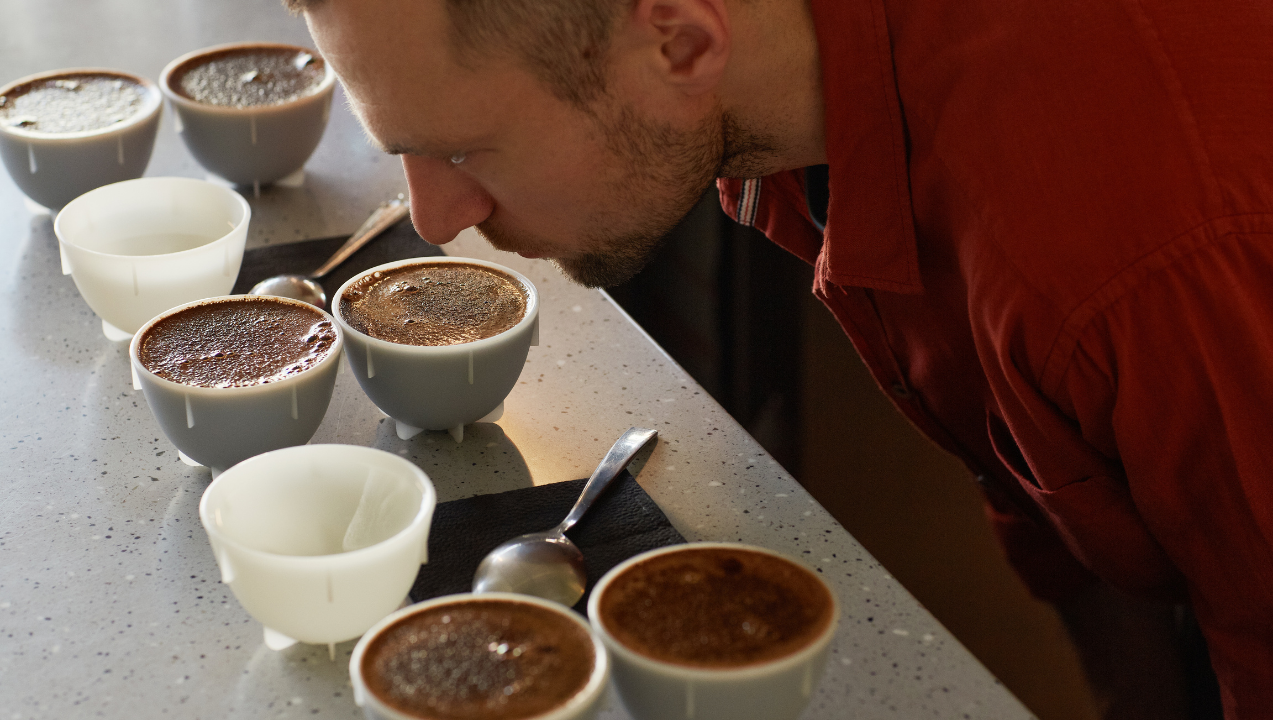
The first step is to taste your product as if you are trying it for the very first time. That sounds straightforward, but it is genuinely difficult after months of development.
Your brain adapts to repeated exposure. It decides the product is safe and familiar, and it stops registering what is off. I met a founder at an event who was genuinely surprised when I told him how earthy his snack was. He had tasted it so many hundreds of times that he had stopped noticing it. For me, tasting it fresh, it was the first thing I noticed. It was nearly all I could taste. He could not have eaten a whole bag of it.
If tasting your own product objectively feels impossible right now, ask someone who has not tried it recently, or ideally never, and ask them the right questions. Does the flavour profile feel right for this type of product and this type of consumer? Are there any notes that feel out of place, like earthy, bitter, or fishy? Does the product feel balanced, or does something feel dominant or missing? How does the flavour behave as you go through the product? Does it fade quickly, linger, or leave an unexpected aftertaste?
Write every observation down. That is your brief. That is what will actually move you forward when you speak to your supplier, not "this flavour is not working."
If you have been living with your product for months and need a fresh, expert perspective before your next round of development, a discovery call is a good place to start. It is a conversation, not a sales pitch, and it often brings more clarity than another set of samples ever would.
Your challenge before the next sample request
Before you reach out to anyone, sit down with your product and do a structured taste audit. Use the four questions above, write down what you find, and use that as your starting point. You might discover the problem is simpler than you thought: a small rebalance of sweetness, a specific ingredient that is interacting badly, or a base that needs attention before any flavour direction can even begin.
The diagnosis is not the glamorous part of product development. But it is the part that determines whether everything else you do actually works.
And if you have done the audit, something is clearly not right, and you are not sure where it is coming from or how to fix it, that is exactly what I am here for. A proper, honest look at your product from someone who has spent over ten years in this industry and knows what to look for.